
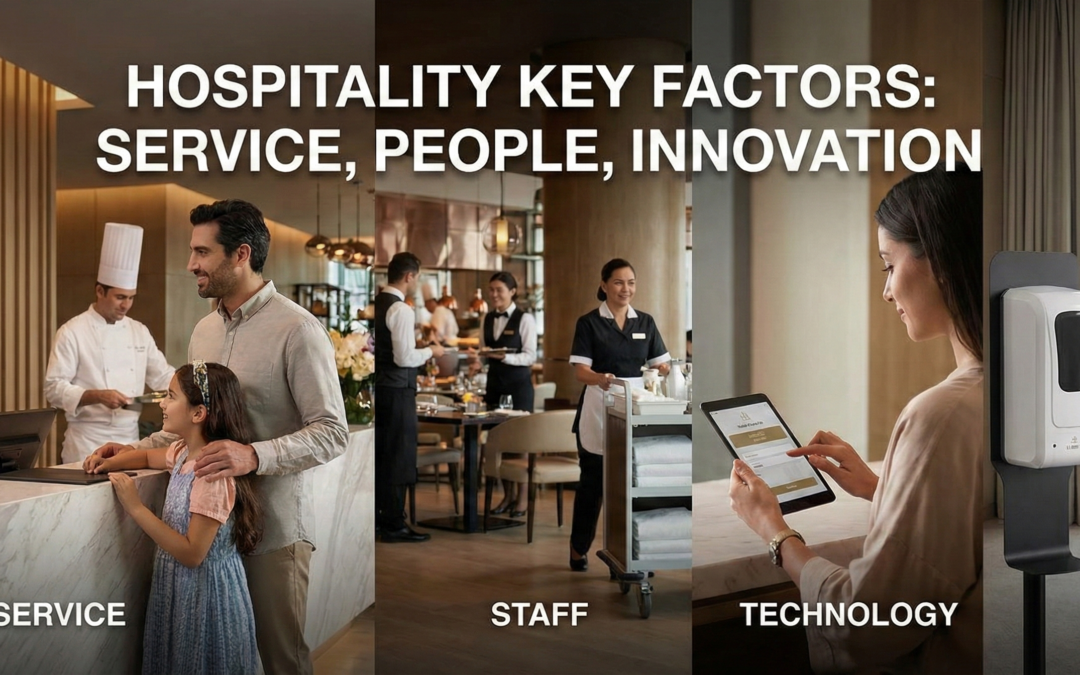
### **1. Guest Experience & Service Quality (The “Soul”)**
This is the single most important factor. It is not just about providing a bed or a meal; it is about how the guest **feels**.
* **Personalization:** Remembering a guest’s name or their preference for a quiet room.
* **Empathy:** The ability of staff to understand and care about the guest’s needs.
* **Speed & Efficiency:** Fast check-ins, quick room service, and immediate conflict resolution.
### **2. Location & Accessibility (The “Hardware”)**
* **Convenience:** Proximity to airports, tourist attractions, or business districts determines a hotel’s success.
* **Visibility:** Being easy to find, both physically (signage) and digitally (Google Maps ranking).
* **Connectivity:** Easy access to public transport or parking facilities.
### **3. Staff & Human Capital (The Engine)**
The hospitality industry relies entirely on people. A beautiful hotel with rude staff will fail.
* **Training:** Constant upskilling in soft skills, language, and technical operations.
* **Attitude:** Hiring for attitude (friendliness, warmth) is often more important than hiring for skill.
* **Retention:** Keeping good staff is crucial because high turnover hurts service quality.
### **4. Hygiene, Safety & Cleanliness**
Since the pandemic, this has moved from a “basic requirement” to a **primary decision factor** for customers.
* **Standards:** Visible sanitation practices (sanitizers, sealed amenities).
* **Security:** Guests must feel safe (24/7 security, cameras, secure locks).
### **5. Technology & Innovation**
Modern hospitality is digital-first.
* **Seamless Booking:** A fast, mobile-friendly website and booking engine.
* **Smart Amenities:** High-speed Wi-Fi (non-negotiable), keyless entry, and smart room controls.
* **Reputation Management:** actively managing reviews on TripAdvisor, Google, and social media.
### **6. Value for Money**
This doesn’t mean “being cheap.” It means the price matches the experience.
* **Perceived Value:** If a guest pays $200, they expect $200 worth of luxury. If they pay $50, they expect $50 worth of cleanliness and basic comfort.
* **Transparency:** No hidden costs or surprise fees.
—Key Factor, Why It Matters
Service, Turns a one-time customer into a loyal regular.
Location, Drives the initial booking decision.
Staff, Delivers the actual experience on the ground.
Reviews, Build trust with future customers.
Recent Comments